Peng Gang Script Font for Bold Brand Identity
It started with a blank brand board—and that familiar mix of excitement and hesitation. I’d just taken on a project for a local ceramic studio: hand-thrown mugs, earthy glazes, quiet confidence in every piece. They wanted something warm but unmistakably strong—no delicate flourishes, no timid curves. Just real, grounded, human-made energy. That’s when I opened my font library and typed “Peng Gang.”
Peng Gang for Logo Design and Handmade Branding
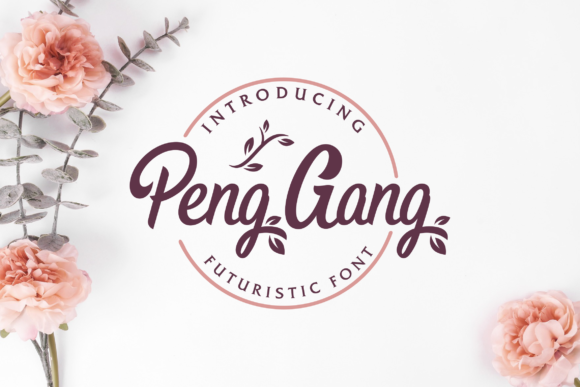
Peng Gang is a bold and authentic script font, and the moment I dropped it into a logo mockup—just the studio’s name in all caps, no extra graphics—it clicked. Not “cute,” not “trendy,” but present. Its thick strokes carry weight without stiffness; the slight irregularity in stroke contrast feels intentional, like ink pressed just a little harder on certain letters. As a Script Handwritten typeface, it avoids the robotic uniformity of many digital scripts—yet it’s clean enough to scale from a tiny business card to a 36” wall banner. I tested it at 14pt on a label sticker: still legible. At 120pt on a shop sign: commanding, but never shouting.
Peng Gang for T-Shirt Printing and Merchandise Design
We moved fast to merch—because that’s where handmade brands live most authentically. I layered Peng Gang across the chest of a charcoal tee: “Clay & Co.” The font’s natural rhythm gave the phrase movement, like a potter’s wheel spinning just right. Unlike some script fonts that collapse or blur when screen-printed, Peng Gang holds its shape beautifully—even at small sizes and on textured cotton. No thin hairlines to vanish in the print process. No awkward spacing between letters that needs manual kerning. As one of the more versatile Fonts I’ve used for apparel, it works equally well centered on a pocket or arched over a back graphic. Bonus: it pairs effortlessly with a sturdy sans serif (I went with Montserrat Light) for care instructions or taglines—Peng Gang as the voice, the sans as the quiet support.
Peng Gang for Packaging Design and Product Labels
Next came the packaging: matte kraft boxes, minimalist stamp-style labels, unbleached twine. This is where Peng Gang really shined—not as decoration, but as identity. On a 2” x 3” label for a mug set, the font’s boldness ensured instant recognition on a crowded shelf. Its authenticity reinforced the studio’s story: no stock imagery, no AI-generated vibe—just craft, consistency, and care. As a Script Handwritten option, it avoided the sterility of a generic script while staying professional enough for retail. I tested it alongside serif body text (Lora) on a product insert—Peng Gang for the headline (“Stoneware Since 2018”), serif for the story beneath. The contrast felt organic, not forced.
Peng Gang for Social Media Graphics and Editorial Design
Instagram was next. For carousel posts showing glaze variations, I used Peng Gang in oversized headlines—cropped tightly, almost tactile. It looked great against raw clay textures and soft-shadowed studio photos. Because Peng Gang is a bold and authentic script font, it didn’t compete with the imagery; it anchored it. In editorial layouts—like a printed zine the studio planned to offer—I used it sparingly: only for section openers and pull quotes. That’s where its strength as a display font shines: not for long paragraphs, but for moments that need to land. It’s not a body font, and it doesn’t pretend to be. But as a logo font or accent typeface? Absolutely reliable.
Peng Gang for Sports Branding and Activewear Identity
Later that week, a friend asked me to review concepts for her new women’s running collective—“Trail & Tempo.” She needed energy, motion, and approachability—not aggression. I swapped in Peng Gang for the logotype. Instant lift. Its forward-leaning slant and confident terminals suggested stride and rhythm. On performance fabric tags and race-day banners, it stayed sharp and spirited. As one of the few Fonts that reads clearly at distance *and* feels personal up close, Peng Gang bridged sport and soul. No ligatures or alternates were needed—the base character set carried full expression. And yes, it’s fully licensed for commercial use, including merchandise and digital ads—no licensing surprises mid-project.
Peng Gang for Wedding Invitations and Elegant Branding
I also tested Peng Gang in a quieter context: a wedding stationery suite for a client who loved raw linen, dried florals, and understated luxury. Paired with a fine serif (Cormorant Garamond), Peng Gang became the gentle anchor—used only for names and dates. Its authenticity read as sincerity, not informality. It’s not overly ornate, so it didn’t clash with delicate paper textures or foil stamping. As a Script Handwritten font, it added warmth without sacrificing elegance. And because it’s designed for clarity across contexts, it held up flawlessly on both digital RSVP cards and letterpress-printed envelopes.
How to Test Peng Gang Before Full Brand Rollout
Before locking anything in, I always run three quick checks: First, export a PNG of the logo at 100px wide—does it read on mobile? With Peng Gang, yes. Second, paste the font into a real email subject line preview—does it render cleanly across clients? Yes, especially when embedded as outlined text or SVG. Third, print a sample on the actual substrate—kraft paper, cotton jersey, vinyl banner. Every time, Peng Gang delivered consistent weight and presence. It’s not a “one-size-fits-all” font—but it *is* a “one-font-that-works-where-it-matters” font.
Peng Gang Font Pairing Tips for Professional Designers
For pairing: lean into contrast. Peng Gang thrives beside clean, neutral sans serifs (Inter, Poppins), classic serifs (Playfair Display, Lora), or even monospaced accents for tech-forward spins. Avoid pairing it with other script fonts—that dilutes its bold authenticity. And skip ultra-thin or overly geometric companions; they’ll make Peng Gang feel heavy or dated. When in doubt, use it solo—on signage, social headers, or packaging—and let its confidence do the work. As a premium Fonts choice, it earns its place not through novelty, but through reliability across real-world applications: logos, t-shirt printing, sports branding, packaging, invitations, and beyond.