Binlay Script Font for Professional Branding
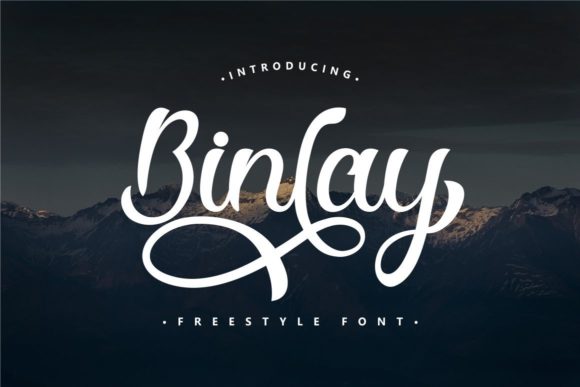
As a small business owner who’s designed everything from coffee bag labels to Instagram story templates, I know how much a single Script Handwritten font can shape how customers perceive your brand. Binlay is a distinct and stylish script font — elegant but never fussy, expressive but always legible. Its ravishing style strikes that rare balance: it feels personal and hand-crafted, yet polished enough for premium packaging, website headers, or boutique storefront signage. If you’re tired of fonts that look either too stiff or too chaotic, Binlay delivers warmth, consistency, and quiet confidence across every customer touchpoint.
Binlay for Wedding Invitations and Elegant Branding
When your business centers on life’s meaningful moments — think wedding planning services, luxury stationery shops, or fine-art portrait studios — Binlay instantly elevates your visual voice. This Script Handwritten font carries subtle flourishes and graceful letter connections that read as intentional, not accidental. Because Binlay is PUA encoded, you can access all alternate glyphs and swashes with one click in design apps like Illustrator or Canva — no workarounds needed. Use the swash capitals for “Mr. & Mrs.” on invites, then switch to clean lowercase for RSVP details. That flexibility means one Fonts purchase supports both high-impact headlines and refined body text — saving time and reinforcing brand cohesion.
Binlay for Product Labels and Handmade Packaging
If you make candles, bath salts, small-batch jams, or ceramic mugs, your product label is often the first physical impression customers have. Binlay works beautifully at 14–18 pt sizes on matte sticker stock or kraft paper tags — its open letterforms and consistent stroke weight hold up even when printed small. Unlike overly delicate script fonts, Binlay avoids thin hairlines that disappear in offset printing or fade on thermal labels. Try pairing it with a clean sans serif (like Montserrat or Inter) for ingredients or care instructions: Binlay becomes your brand’s signature voice, while the supporting typeface ensures clarity and trust. That contrast says “artisan-made, professionally presented.”
Binlay for Café Menus and Local Business Signage
Your café menu isn’t just a list — it’s part of the experience. Binlay adds personality without sacrificing readability. Use it for section headers (“Pastries,” “Specialty Drinks”) or featured item names (“Honey Lavender Latte”), then pair with a highly legible serif or geometric sans for prices and descriptions. Because Binlay is a Script Handwritten font with generous spacing and balanced x-height, it scales well on wall menus, chalkboard-style digital displays, and takeout bag stamps. Customers subconsciously associate that confident, flowing rhythm with authenticity and care — exactly what local food and beverage brands need to stand out in crowded neighborhoods.
Binlay for Social Media Graphics and Instagram Story Templates
On Instagram or Pinterest, where visuals compete in under two seconds, Binlay helps your posts stop the scroll. Its ravishing style shines in quote graphics, limited-time offer banners, or new product teasers — especially when layered over soft textures or muted photography. Since Binlay is PUA encoded, you can quickly swap in stylistic alternates (like a looping ‘g’ or elegant ‘y’) to keep recurring content feeling fresh, not repetitive. For stories, use Binlay in bold headline positions only — avoid long paragraphs. It’s a display font, not a body font — and used intentionally, it builds recognition faster than any filter or template.
Binlay for Logo Design and Small Business Brand Identity
Your logo appears everywhere: on your website favicon, email signature, receipt stamp, and delivery box tape. That’s why choosing a Script Handwritten font like Binlay matters deeply. Its distinctive lowercase ‘a’, ‘e’, and ‘s’ give your wordmark character without leaning into trendiness that dates quickly. Test it at tiny sizes (16x16 px) — does the shape remain recognizable? With Binlay, yes. It’s designed with brand longevity in mind. Just remember: always verify commercial licensing before embedding Binlay in logos for client work, merchandise, or digital templates you sell. Most reputable Fonts vendors include clear usage terms — and Binlay’s license covers exactly those real-world business needs.
Binlay for Thank-You Cards and Customer-Facing Print Materials
A handwritten note feels special — but scaling that warmth across dozens of orders isn’t realistic. Binlay bridges the gap. Use it for “Thank You” headers on printed cards, packaging inserts, or loyalty program certificates. Its natural rhythm mimics human penmanship, making automated touches feel personal. Pair it with a warm, low-contrast serif (like Cormorant Garamond) for short messages underneath — the combination feels considered, not generic. And because Binlay is PUA encoded, you can insert custom ligatures or end swashes to add subtle distinction between customer segments (e.g., a floral swash for bridal clients, a minimal dot for corporate gifting).
Binlay for Website Headers and Digital Brand Consistency
Your website header is prime branding real estate — and Binlay performs exceptionally there. As a Script Handwritten display font, it sets tone immediately: creative, approachable, detail-oriented. Use it for H1s, hero section headlines, or CTA buttons (“Book Your Session,” “Shop New Arrivals”). Then step down to a neutral, highly readable web font (like Open Sans or Lato) for body copy. This pairing creates hierarchy, improves accessibility, and reinforces professionalism. Bonus: Binlay’s consistent baseline and ascender/descender proportions prevent awkward line breaks or uneven spacing — critical for responsive layouts on mobile devices.
How to Test Binlay Before Full Brand Rollout
Before committing to Binlay across your entire brand system, run three quick tests: (1) Print a sample product label at actual size on your intended material; (2) Post a mockup using Binlay on Instagram Stories and view it on an iPhone screen — does the flow still read clearly? (3) Ask two customers unfamiliar with your brand: “What three words describe this font?” If answers align with your brand values (e.g., “elegant,” “trusted,” “handmade”), you’ve got a strong match. Binlay isn’t meant to be everywhere — it’s meant to be *noticed*, remembered, and associated with your business’s best qualities.